Three Ancient Egyptian Novels

This paperback compendium edition combines Naguib Mahfouz’s first three novels, all set in ancient Egypt, which skillfully explore recurring themes within human relationships: the balance between destiny and individual agency, the sanctity of the bonds to the land and religion, and the constant power struggles that affect human lives at multiple levels. In Khufu’s Wisdom, translated by Raymond Stock, Pharaoh Khufu is battling the Fates. At stake is the inheritance of Egypt’s throne, the proud but tender heart of Khufu’s beautiful daughter Princess Meresankh, and Khufu’s legacy as a sage, not savage, ruler. Rhadopis of Nubia, translated by Anthony Calderbank, follows the powerful love that grows between Rhadopis, a courtesan whose ravishing beauty is unmatched in time or place, and youthful, headstrong Pharaoh Merenra, worshiped by his people as a divine presence on earth, against the background of the high politics of Sixth Dynasty Egypt. Finally, in Thebes at War, translated by Humphrey Davies and written in 1937–1938 when Britain and Turkey held sway over Egypt, Mahfouz dramatically depicts the Egyptian people’s undying loyalty to their land and religion and their refusal to bow to outside domination. After two hundred years of occupation, the Hyksos leader in his capital in northern Egypt tells Pharaoh in the south that the roaring of the sacred hippopotami at Thebes is keeping him awake at night and demands that they be killed, galvanizing Egypt into hurling its armies into a struggle to drive the barbarians from its sacred soil forever.

Cairo Modern

(2013) القاهرة الجديدة The novelist’s camera pans from the dome of King Fuad University (now Cairo University) to students streaming out of the campus, focusing on four students in their twenties, each representing a different trend in Egypt in the 1930s. Finally the camera comes to rest on Mahgub Abd al-Da’im. A scamp, he fancies himself a nihilist, a hedonist, an egotist, but his personal vulnerability is soon revealed by a family crisis back home in al-Qanatir, a dusty, provincial town on the Nile that is also a popular destination for Cairene day-trippers. Mahgub, like many characters in works by Naguib Mahfouz, has a hard time finding the correct setting on his ambition gauge. His emotional life also fluctuates between the extremes of a street girl, who makes her living gathering cigarette butts, and his wealthy cousin Tahiya. Since he thinks that virtue is merely a social construct, how far will our would-be nihilist go in trying to fulfill his unbridled ambitions? What if he discovers that high society is more corrupt and cynical than he is? With a wink back at Goethe’s Faust and Henry Fielding’s Joseph Andrews, Mahgub becomes a willing collaborator in his own corruption. Published in Arabic in the 1940s, this cautionary morality tale about self-defeating egoism and ill-digested foreign philosophies comes from the same period as one of the writer’s best-known works, Midaq Alley. Both novels are comic and heartfelt indictments not so much of Egyptian society between the world wars as of human nature and our paltry attempts to establish just societies.

Woman from Tantoura

Palestine. For most of us, the word brings to mind a series of confused images and disjointed associations-massacres, refugee camps, UN resolutions, settlements, terrorist attacks, war, occupation, checkered kouffiyehs and suicide bombers, a seemingly endless cycle of death and destruction. This novel does not shy away from such painful images, but it is first and foremost a powerful human story, following the life of a young girl from her days in the village of al-Tantoura in Palestine up to the dawn of the new century. We participate in events as they unfold, seeing them through the uneducated but sharply intelligent mind of Ruqayya, as she tries to make sense of all that has happened to her and her family. With her, we live her love of her land and of her people; we feel the repeated pain of loss, of diaspora and of cross-generational misunderstanding; and above all, we come to know her indomitable human spirit. As we read we discover that we have become part of Ruqayya’s family, and her voice will remain with us long after we have closed the book.

Nasser, My Husband

(2013) A new and intimate portrait of an iconic world figure by the one who knew him best—his wife Gamal Abdel Nasser, architect of Egypt’s 1952 Revolution, president of the country from 1956 to 1970, hero to millions across the Arab world since the Suez Crisis, was also a family man, a devoted husband and father who kept his private life largely private. In 1973, three years after his early passing at the age of 52, his wife Tahia wrote a memoir of her beloved husband for her family. The family then waited almost forty years, through the presidencies of Anwar Sadat and Hosni Mubarak, both unsympathetic to the memory of Nasser, before publishing Tahia’s book in Arabic for the first time in 2011. Now this unique insight into the life of one of the giants of the twentieth century is finally available in English. Accompanied by more than one hundred photographs from the family archive, many never before published, this historic book tells the story of Gamal and Tahia’s life together from their marriage in 1944, through the Revolution and Gamal’s career on the world stage, revealing an unknown and intimate picture of the man behind the president. “At 6:30am on the morning of July 23, 1952 there was a knock on the door. Tharwat Okasha shook my hand and congratulated me: ‘The military coup has succeeded.’ I asked him about Gamal. ‘He is close by, not more than five minutes away at the General Command.’ At 9:30am an officer called: he had come from the General Command at Kubri al-Qubba, sent by Colonel Gamal Abdel Nasser to tell me that he was fine and would not be home for lunch.

Dreams

(2013) In his shortest short stories, the Egyptian Nobel literature laureate reduced the fictional form to its most essential level, while retaining his justifiably famous mastery of the storytelling art. A man finds that all the streets in his neighborhood have turned into a circus—but his joy at the sight changes to anger when he sees he cannot escape it anywhere, even in his own home. A group of lifelong friends meet to trade jokes in a familiar alley—only to face a sudden, deadly flood that echoes the revenge taken by an ancient Egyptian queen upon the men who murdered her husband. A girl from the dreamer’s childhood flies with him from his native lane on a cart drawn by a winged horse, to become a star in the firmament above the Great Pyramid. Such is the stuff of Naguib Mahfouz’s The Dreams—his only major work after a knife attack by a religious fanatic in 1994 left him unable to write for several years. First serialized in a Cairo magazine, The Dreams are a unique and haunting mixture of the deceptively quotidian, the seductively lyrical, and the savagely nightmarish—the richly condensed sum of more than nine decades of artistic genius and everyday experience.

Karnak Cafe

In this gripping and suspenseful novella from the Egyptian Nobel Prize-winner, three young friends survive interrogation by the secret police, only to find their lives poisoned by suspicion, fear, and betrayal. At a Cairo café in the 1960s, a legendary former belly dancer lovingly presides over a boisterous family of regulars, including a group of idealistic university students. One day, amid reports of a wave of arrests, three of the students disappear: the excitable Hilmi, his friend Ismail, and Ismail’s beautiful girlfriend Zaynab. When they return months later, they are apparently unharmed and yet subtly and profoundly changed. It is only years later, after their lives have been further shattered, that the narrator pieces together the young people’s horrific stories and learns how the government used them against one another. In a riveting final chapter, their torturer himself enters the Café and sits among his former victims, claiming a right to join their society of the disillusioned. Now translated into English for the first time, Naguib Mahfouz’s tale of the insidious effects of government-sanctioned torture and the suspension of rights and freedoms in a time of crisis is shockingly contemporary.

Tales of Encounter

(2012) Yusuf Idris was undoubtedly one of Egypt’s most talented and versatile writers in the second half of the twentieth century. The first two novellas in this volume, Madam Vienna and The Secret of His Power, come from the peak period in his career, the late 1950s and early 1960s, while New York 80 belongs to his late period, the 1980s. Yet something holds these three works together, despite their different periods and their scattered settings: Vienna, an Egyptian Delta village, and New York. They all deal with a seminal theme in Arabic fiction since its nascent years and until today: the East-West encounter, often treated allegorically by Arab writers through a love story between an Arab man and a Western woman who stand for their respective cultures. In these three novellas, Idris harnesses his remarkable narrative skills to tell us some of the most memorable stories of the encounter in Arabic fiction.

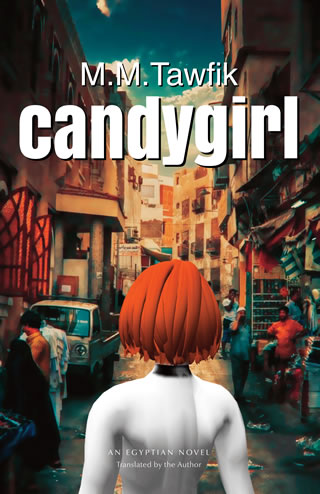
Candygirl

(2012) فتاة الحلوى (English) From the author of Murder in the Tower of Happiness Trying to evade intelligence agencies out to assassinate him, the Cerebellum, an Egyptian scientist with a past association with the Iraqi nuclear program, rents a room on the roof of a brothel in a Cairo slum. His interaction with the other residents is limited; instead he spends most of his time in the virtual world, where he has a love affair with candygirl, a gorgeous avatar. On the other side of the planet, an ex-NSA agent has joined a secret organization whose mission is to assassinate Iraqi scientists. He does not allow his doubts about the legality—or the ethics—of his mission to interfere with his work. He chases his victim relentlessly, but when his top-of-the-line equipment fails to locate the Cerebellum in Cairo’s slums, he takes the chase to the virtual world.

Days in the Diaspora

(2012) ايام الشتات (English) The quest for identity of a Muslim Jewish Egyptian immigrant in 1960s Paris “How could a good Muslim boy like you be born into a Jewish family!” For Galal, forced to leave Egypt in the 1960s Jewish exodus with his family, the Diaspora has none of the beauty of a rich tapestry of history; it is a day-to-day struggle to fit into his new life in Paris, reconcile the conflicting demands of family and friends, and come to terms with who he is. The quest for belonging and identity is at the heart of this sensitive and tender narrative. Earthy, rambunctious supporting characters burst from the page, spontaneous, emotional, yet, for all their façade of confidence, no less adrift than Galal himself. Ruhayyim’s Paris of the 1960s is startlingly relevant: then, as now, religion offers an illusory source of community and identity for migrants to the west, not fitting in, yet cut off from their roots. Deeply personal, this unusual, uplifting coming-of-age novel takes us into the heart of an ordinary young man in the grip of an unforgiving historical moment.

Sayyid Qutb and the Origins of

A new biography of the founder of modern Islamist thought Sayyid Qutb (1906–66) was an influential Egyptian ideologue credited with establishing the theoretical basis for radical Islamism in the post-colonial Sunni Muslim world. lacking a pure understanding of his life and work, the popular media have conflated Qutb’s moral purpose with the aims of Bin Laden and al-Qaeda. He is often portrayed as a terrorist, Islamo-Fascist, and advocate of murder. This book rescues Qutb from misrepresentation, tracing the evolution of his thought within the context of his time, recounting Qutb’s life from the small village in which he was raised to his execution at the behest of Abd al-Nasser’s regime. His study remains sensitive to the cultural, political, social, and economic circumstances that shaped Qutb’s thought—major developments that composed one of the most eventful periods in Egyptian history. Only in response to his harrowing experience in prison did Qutb come to regard Islam and kufr (infidelity) as oppositional, antithetical, and therefore mutually exclusive. Calvert shows how Qutb repackaged and reformulated the Islamic heritage to pose a challenge to authority, including those who claimed (falsely, he believed) to be Muslim.