Red Wine

(2015) Suzie Mohamad Galal, born in the Egyptian city of Suez during the War of Attrition in the late 1960s, is a woman of inner conflicts, at once a fighter and a lover, who traverses the boundaries of ethnicity and religion. Her whole life is intricately tied to the wars and political events taking place in Egypt. But as she grapples with where to begin her story of personal and national crises, questions of narration arise: which metaphor best serves the layers of meaning she wants to communicate, and whose voice is telling the story anyway?Red Wine is both timely in its attention to the issues of state brutality, religious extremism, and gender, and timeless in the way it deals with the themes of coming of age, guilt, and sadness.

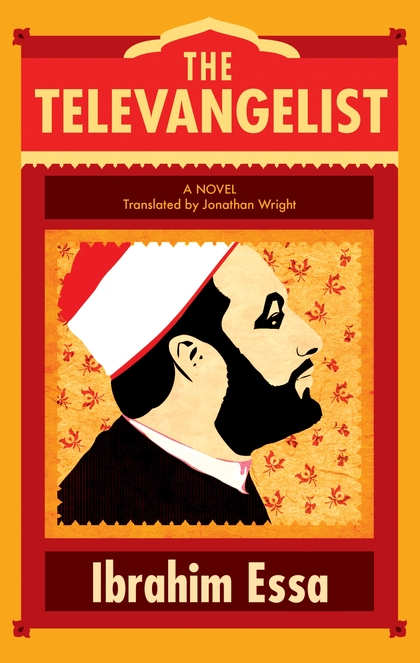
Televangelist

(2016) Meet Egypt’s top TV preacher Hatem el-Shenawi: a national celebrity revered by housewives and politicians alike for delivering Islam to the masses. Charismatic and quick-witted, he has friends in high places. But when he is entrusted with a secret that threatens to wreak havoc across the country, he is drawn into a web of political intrigue at the very heart of government. Can Hatem’s fame and fortune save him from this unspeakable scandal?

Midaq Alley

(2015) This much-loved Mahfouz masterpiece is a rich account of life in a back street in a poor quarter of medieval Cairo. While the novel focuses on a willful young woman whose ambition to escape the confines of the alley leads her into prostitution, a pageant of other vivid characters, from the café owner who likes boys to the man who creates maimed beggars and from the young man with the faithful heart to the rake and the pimp, fleshes out the picture of a society in crisis and transition. Though the novel is set during the Second World War, the characters’ alienation from the prevailing political system and the desire of many of them to escape the economic and social stagnation of the alley give the work an unexpectedly up-to-date flavor. Mahfouz presents his characters with wry humor and a relish for the contradictions and fallibilities innate in people everywhere (even the alley’s beloved spiritual mentor beats his wife).

Harafish

In The Harafish Naguib Mahfouz returns to the style of sweeping narrative at which he proved himself a master. He chronicles the dramatic history of the Nagi family—a family that descends, over many generations, from the heights of power and prestige to the depths of decadence and decay. The epic story begins with the tale of Ashur al-Nagi, a man who grows from humble roots to become a great leader and a legend among his people. The name of Ashur epitomizes a time of glory for the harafish, or the common people, when they were led by one of their own. Generation after generation, however, Ashur’s descendants stray further from his legendary example. They lose touch with their origins as they amass and then lose large fortunes, marry prostitutes when they marry at all, and develop rivalries that end in death. Finally, a Nagi appears who restores the family name to its former distinction.
The Harafish is a mythic tale, a compelling portrait of human weaknesses—pride, dishonesty, lust, and greed—and of the greatness of which we are capable when we overcome them.

Children of the Alley

In this rich and intricate novel, Naguib Mahfouz guides us through the history of an alley whose denizens—some fearsome, most fearful, a few fearless—are all the descendants of one man, Gabalawi, who now keeps himself hidden away in the mansion at the top of the alley. From the supreme feudal lord who disowns one son for cruel pride and puts another to the test, to the savior of a succeeding generation, we observe the men and women of this quintessential Cairo neighborhood unwittingly reenacting the lives of their venerable forebears, telling through their rivalries, battles, love affairs, and miracles the spiritual history of mankind.

Mirage

(2015) A psychological study of the first order with a subtly Freudian flavor, The Mirage is the autobiographical account of Kamil Ru’ba, a tortured soul who finds himself struggling unduly to cope with life’s challenges. The internal torment and angst that dog him throughout his life and the tragic, ironic turns of events that overtake him as a young man are, to a great extent, the outworkings of his faulty upbringing. At the same time, they work together to drive home the novel’s underlying theme: the illusory, undependable nature of the world in which we live and the call to seek, beyond the outward and the ephemeral, that which is inward and enduring. The narrative, full of pathos, draws the reader unwittingly into a vicarious experience of Kamil’s agonies and ecstasies. As such, it is a specimen of Mahfouz’s prose at its finest.

Khan al-Khalili

(February 2015) A major early novel by the Egyptian Nobel Laureate, now in paperback The time is 1942, the Second World War is at its height, and the Africa Campaign is raging along the northern coast of Egypt as far as El Alamein. Against this backdrop of international upheaval, this novel tells the story of the Akifs, a middle-class family that has taken refuge in Cairo’s historic and bustling Khan al-Khalili neighborhood. Believing that the German forces will never bomb such a famously religious part of the city, they seek safety among the crowded alleyways, busy cafés, and ancient mosques of the Khan, adjacent to the area where Mahfouz himself spent much of his young life. Through the eyes of Ahmad, the eldest Akif son and the novel’s central character, Mahfouz presents a richly textured vision of the Khan, drawing on his own memories to assemble a lively cast of characters whose world is framed by the sights, smells, and flavors of his childhood home. As Ahmad, a minor civil servant who has sacrificed both education and personal ambition in order to support his family, interacts with the people and traditions of Khan al-Khalili, a debate emerges that pits old against new, history against modernity, and faith against secularism. Addressing one of the fundamental questions of the modern era, Mahfouz asks whether, like the German bombs that threaten Khan al-Khalili daily, progress must necessarily be accompanied by the destruction of the past.

Thief and the Dogs

(2015) One of Mahfouz’s best loved works, a tale of obsessional revenge, now in paperback A thriller in form, a political and ethical analysis in substance. A professional thief and would-be killer, Said is an Egyptian Robin Hood whose thefts are motivated by powerful egalitarian principles, as well as by bitterness. His burning desire for revenge against those who betrayed him to the police carries him to the heights and depths of Cairo society during the early years of the 1952 Revolution.

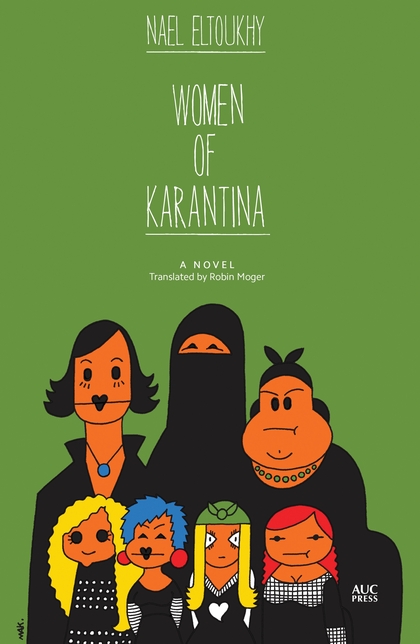
Women of Karantina

(2015) نساء الكرنتينا Back in the dog days of the early twenty-first century a pair of lovebirds fleeing a murder charge in Cairo pull in to Alexandria’s main train station. Fugitives, friendless, their young lives blighted at the root, Ali and Injy set about rebuilding, and from the coastal city’s arid soil forge a legend, a kingdom of crime, a revolution: Karantina. Through three generations of Grand Guignol insanity, Nael Eltoukhy’s sly psychopomp of a narrator is our guide not only to the teeming cast of pimps, dealers, psychotics, and half-wits and the increasingly baroque chronicles of their exploits, but also to the moral of his tale. Defiant, revolutionary, and patriotic, are the rapists and thieves of Alexandria’s crime families deluded maniacs or is their myth of Karantina—their Alexandria reimagined as the once and future capital—what they believe it to be: the revolutionary dream made brick and mortar, flesh and bone? Subversive and hilarious, deft and scalpel-sharp, Eltoukhy’s sprawling epic is a masterpiece of modern Egyptian literature. Mahfouz shaken by the tail, a lunatic dream, a future history that is the sanest thing yet written on Egypt’s current woes.

Homecoming

The award-winning translator of Arabic literature Denys Johnson-Davies presents an anthology of short fiction from more than half a century. Denys Johnson-Davies brings together this remarkable overview of the work of several generations of Egypt’s leading short story writers. This selection of some fifty stories represents not only a cross-section through time but also a spectrum of styles, and includes works by Teymour, Hakki, Gohar, and Mahfouz and later writers such as Mohamed El-Bisatie, Said el-Kafrawi, Bahaa Taher, and Radwa Ashour, as well as new young writers of today like Hamdy El-Gazzar, Mansoura Ez Eldin, and Youssef Rakha.