Committee

Sonallah Ibrahim has been called the Egyptian Kafka. And no wonder: this wry tale revolves around its narrator’s attempts to petition successfully the elusive “Committee.” Consequences for his actions range from the absurd to the hideous.
In Kafkaesque fashion—an intriguingly symbolic and minimalist style—Ibrahim offers an unbroken first-person narrative rendered in brief, crisp prose framed by a conspicuous absence of vivid imagery. Furthermore, the petitioner is a man without identity. The ideal antihero, he remains unnamed throughout the intricate plot, with a locale suggestive of 1970s Cairo.
The Committee, first published in Arabic in 1981, sardonically pierces the inflammatory terrain between ordinary men, unbridled displays of power, and other broader concerns of the author’s native Egypt. The novel’s corrosive, shocking conclusion catapults satiric surrealism into a new realm.

City of Love and Ashes

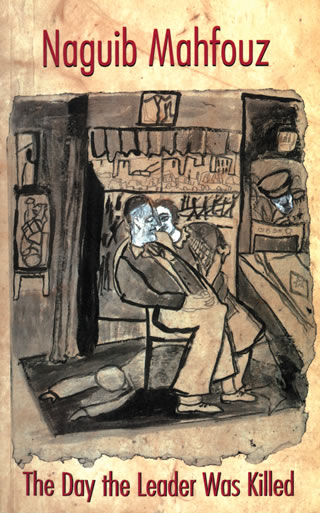
Day the Leader Was Killed

In this breathtakingly compact novel, written in the mid-1980s, the focus is once again on the generational paradigm featured in the Cairo Trilogy.
This time, Mahfouz traces the life of a middle-class Cairene family living in the early 1980s under President Sadat. It was an era of transition in Egypt, a time of acute crisis, as everywhere ordinary people were being pushed into the ‘’abyss of Infitah.’’ In the mad rush, there was a sense of an ending, a feeling of panic as the innocent helplessly watched their world rapidly disintegrating. A whole way of life with its age-old traditions and values was simply falling apart, making way for a merciless new materialism in ‘’the kingdom of the corrupt,’’ where survival had indeed to be for the fittest.
The novel reaches its climax with the assassination of Sadat on October 6, 1981, an event around which the fictional plot is skillfully woven.

Architecture for the Poor

In this now classic work, Hassan Fathy, Egypt’s greatest twentieth-century architect, describes in detail his plan for building the village of New Gourna on the west bank of the Nile at Luxor, employing both the traditional building material, mud brick, and such traditional Egyptian architectural features as enclosed courtyards and domed and vaulted roofing. Fathy worked closely with the people to tailor his designs to their needs; he taught them how to work with the mud bricks, supervised the erection of the buildings, and encouraged the revival of ancient techniques, such as the use of claustra (mud-brick latticework) to adorn the buildings. Although bureaucratic red tape and other problems prevented the completion of New Gourna, Fathy’s ideas have since commanded widespread attention both inside and outside Egypt, and Architecture for the Poor remains a testament to his vision as an architect of conscience. “Fathy demonstrates very powerfully that it is possible to build for the poor … cheaply and humanly by the use of earth for building and by teaching people to build for themselves. There is no other book quite like this.” —Choice

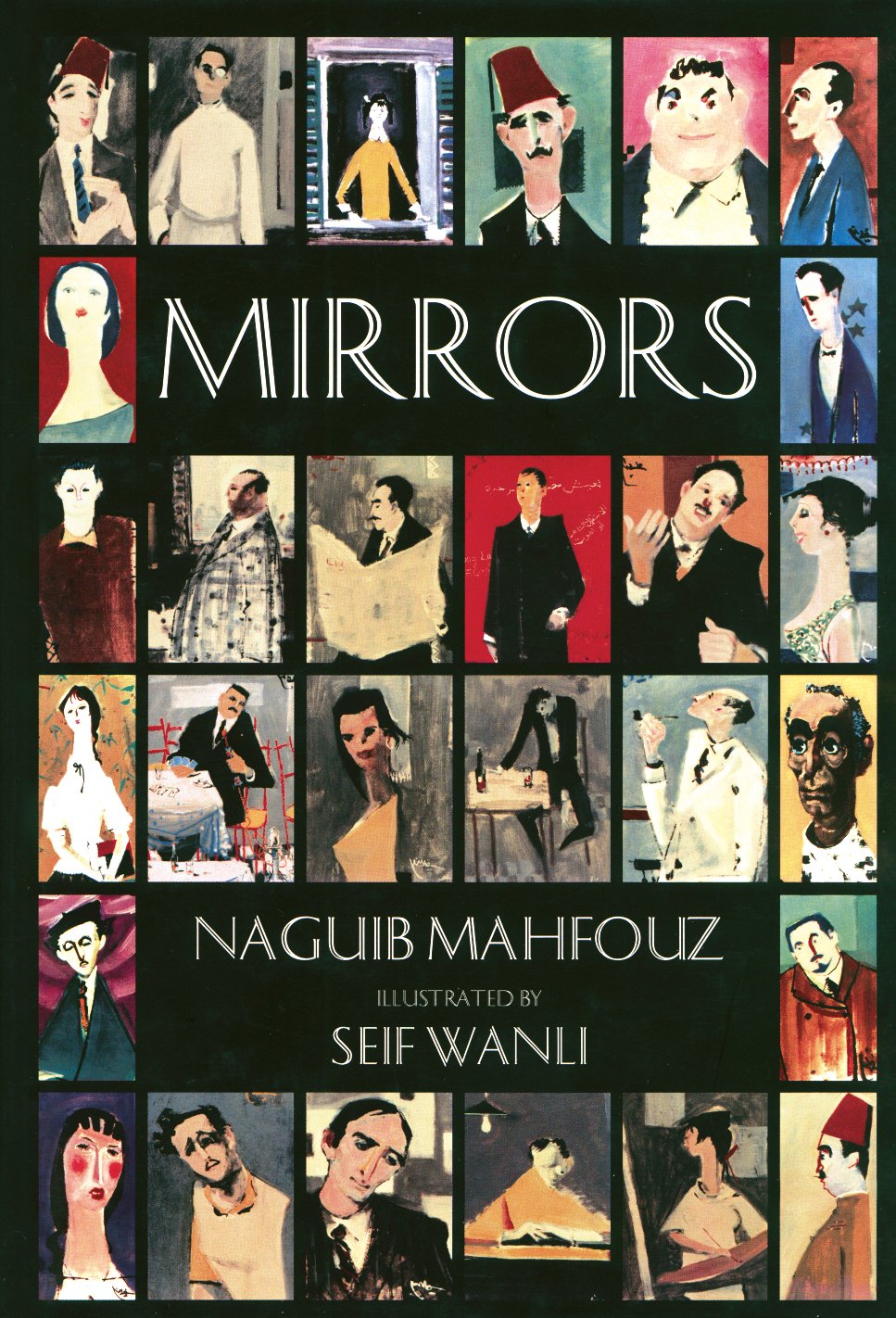
Mirrors

Mirrors is one of Nobel laureate Naguib Mahfouz’s more unusual works. First published in serialized form in the Egyptian television magazine, it consists of a series of vignettes of characters from a writer’s life―a writer very like Mahfouz himself. And accompanying each vignette is a portrait of the character by a friend of the author, the renowned Alexandrian artist Seif Wanli.

Through each vignette―whether of a lifelong friend, a sometime adversary, or a childhood sweetheart―not only is that one character described but much light is thrown on other characters already familiar or yet to be encountered, as well as on the narrator himself, who we come to know well through the mirrors of his world of acquaintances.

At the same time, Mirrors also reflects the recent history of Egypt, its political movements, its leaders, its wars, and its peace, all of which affect the lives of friends and enemies and of the narrator himself. As the translator writes in his introduction, “the narrator’s acquaintances from childhood, schooldays, and civil service career take him from the lofty heights of intellectual salons to the seamy squalor of brothels and drug dens; from the dreams of youth and nationalistic ideals to the sobering realities of post-revolutionary society and clashing economic and political values.”

Journey of Ibn Fattouma

First published in Arabic in 1983, this brief but powerful parable is set in a mythical, timeless Middle East. It is presented as the journal of a wanderer known as Ibn Fattouma, whose boyhood tutor had extolled the virtues of travel as a way of finding the true meaning of life.

He joins a caravan and sets out to explore the world, his ultimate destination the enigmatic land of Gebel.

Raised in an Islamic society, Ibn Fattouma finds to his surprise that many of the countries he visits, though heathen, are in some ways superior to his own. His first stop results in marriage to a non-believer, and children. However, war with another country and a clash with a city official cause him to lose his family, and he is forced to leave. In another country he is imprisoned for twenty years, accused of crimes against the state. Civil war frees him, and he moves on again, always seeking an intangible he is never able to find, always vulnerable to the winds of social and political change.

Finally, he joins a caravan bound for Gebel—a country so distant and mysterious that no one has ever been known to reach it and return to tell the tale.

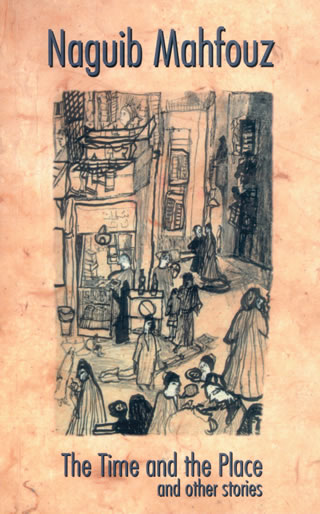
Time and the Place

These twenty stories represent nearly thirty years of Mahfouzs career. Selected and translated by the distinguished scholar Denys Johnson-Davies, they have all the celebrated and distinctive characters and qualities found in Mahfouzs novels: the denizens of the narrow alleyways of Cairo; dark ruminations on death; experiments with the supernatural; and witty excursions into Cairene middle-class life.

Respected Sir

Othman Bayyumi joins the civil service at the lowest point of the professional scale as an archives clerk. From the first minute in his career he is seized by a mad desire to become one day director-general of the department, and his eagerness to fulfill this ambition becomes an exalted and arduous religious quest, for the sake of which no sacrifice is too great.

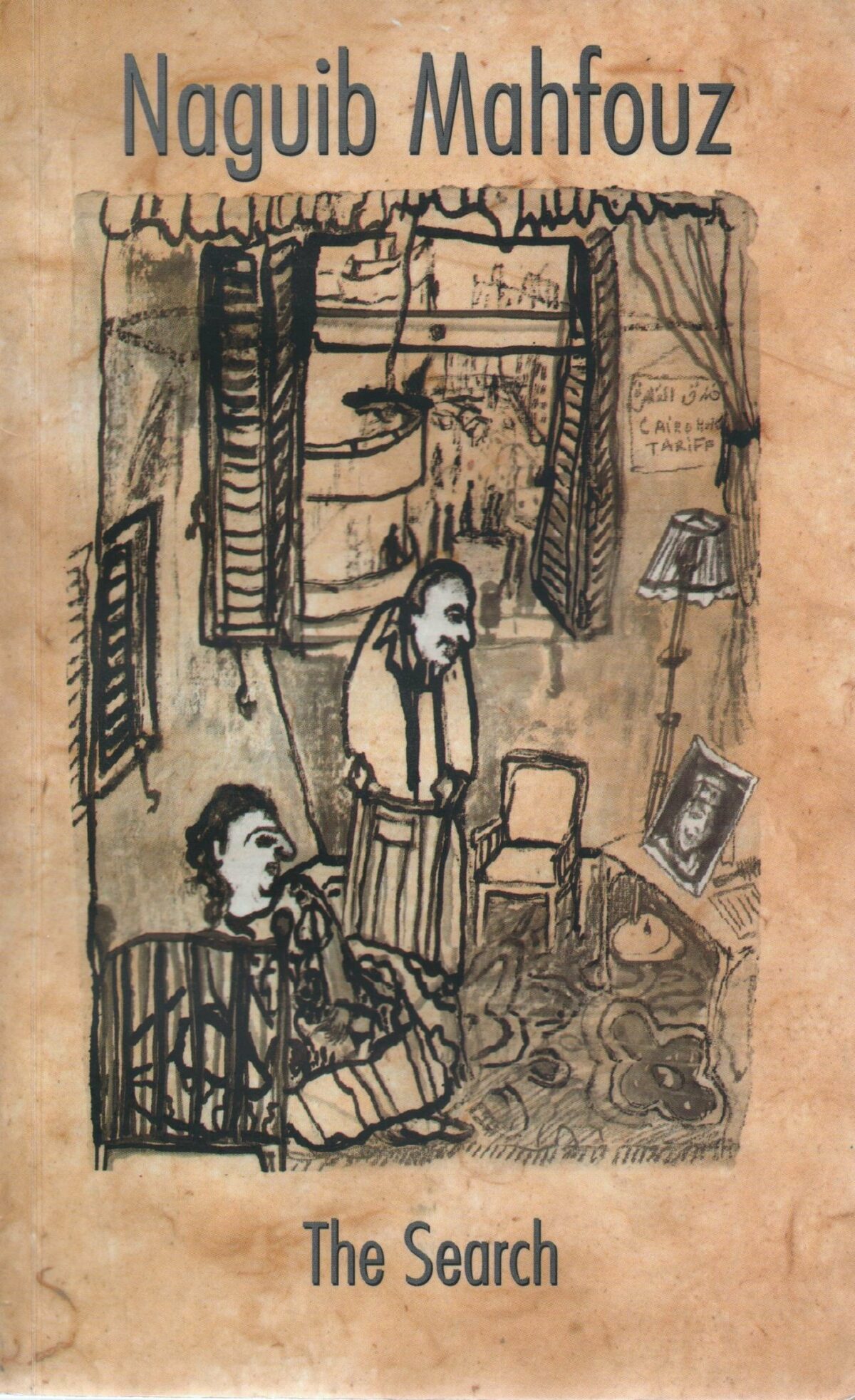
Search

In The Search a young man, hoping to escape a sordid background and an impoverished future, sets out to find the father he has never known. But in the course of his quest he becomes entangled with two women and is enticed into murder. The significance of the novel lies mainly in its symbolic nature and in its possible readings: is the young man searching for his roots, for religious belief, for national traditions, or for political identity?

Wedding Song

This is the story of a theatrical family of Cairo, whose playwright son exposes its most intimate and sordid secrets on the stage in his first play. The story is told four times from four different viewpoints: that of the family acquaintance, the father, the mother, and Abbas, the son, who is the central character.