Complete Gods and Goddesses of Ancient Egypt

The gods and goddesses of ancient Egypt are among the most fascinating of human civilization. The lives of pharaohs and commoners alike were dominated by the need to honor, worship, and pacify the huge pantheon of deities, whose surpassing richness and complexity is reflected in countless tributes throughout Egypt. This book examines the evolution, worship, and eventual decline of the gods and goddesses—from minor figures such as Bes and Taweret to the all-powerful deities Amun and Re—that made Egypt the most completely theocratic society of the ancient world, and made Egyptians, according to Herodotus, ‘more religious than any other people.’ The Complete Gods and Goddesses of Ancient Egypt is richly illustrated and includes specially commissioned drawings that show everything from lavish tomb paintings and imposing temple reliefs to statues of the gods themselves, while the unique thematic organization of the deities into their major groupings allows for easy cross-referencing and comparison.

Cairo Illustrated

Cairo is an exploding modern metropolis of eighteen million people that nevertheless preserves within its heart the finest medieval city in the world, its alleys, mosques, and caravanserais the original setting for the Arabian Nights, whose atmosphere is palpable still for the visitor wandering through its bazaars, while at sunset the Pyramids glow gold against the Western Desert as they have done for one million seven hundred thousand evenings past. The monuments of pharaohs and sultans lie within the city’s reach, making Cairo and its environs an unequaled storehouse of human achievement. In this guide to the largest city in Africa and the political and cultural fulcrum of the Arab world, Michael Haag explores Cairo’s past and present in word and picture, from Saqqara to the Citadel of Saladin, from the ancient synagogue and churches of Old Cairo to the skyscrapers along the Nile, from Khan al-Khalili, the vast bazaar as intricate as inlay work, to the Belle Epoque façades of the downtown streets, and introduces you to the treasures of three great civilizations at the Islamic, Coptic, and Egyptian Antiquities museums. Beautifully illustrated with 150 color photographs, this is a fascinating armchair tour of Cairo in all its variety.

Cairo Inside Out

(2016) A whole new approach to seeing one of the world’s great cities Cairo is a city of splendor and spectacle, long celebrated as much for its warmth and bustling street life as for the legacy of its tumultuous past. Yet for the countless visitors who fall under its spell, the prolonged din of its crowds and traffic can seem overwhelming at times, tempting them out of the city’s open spaces into its shadow light, the cooler, quieter interiors of restaurants, homes, hotels, and terraces. Cairo Inside Out evokes the light and moods of this great metropolis with stunning photographs shot from the city’s indoor havens. We observe it through and from nostalgic haunts, such as Café Riche and the Windsor Hotel, and look out onto its great sights—the Nile, the Red Pyramid at Dahshur, Ibn Tulun mosque—from the most intimate urban interiors, homes, and watersides. For those who may have lived in Cairo, this is a reminder of a city that moves and yet remains wonderfully unchanged. For visitors and residents, this evocative collection, an unabashed homage to Cairo’s persistent color and allure, will inspire them to visit those places once more.

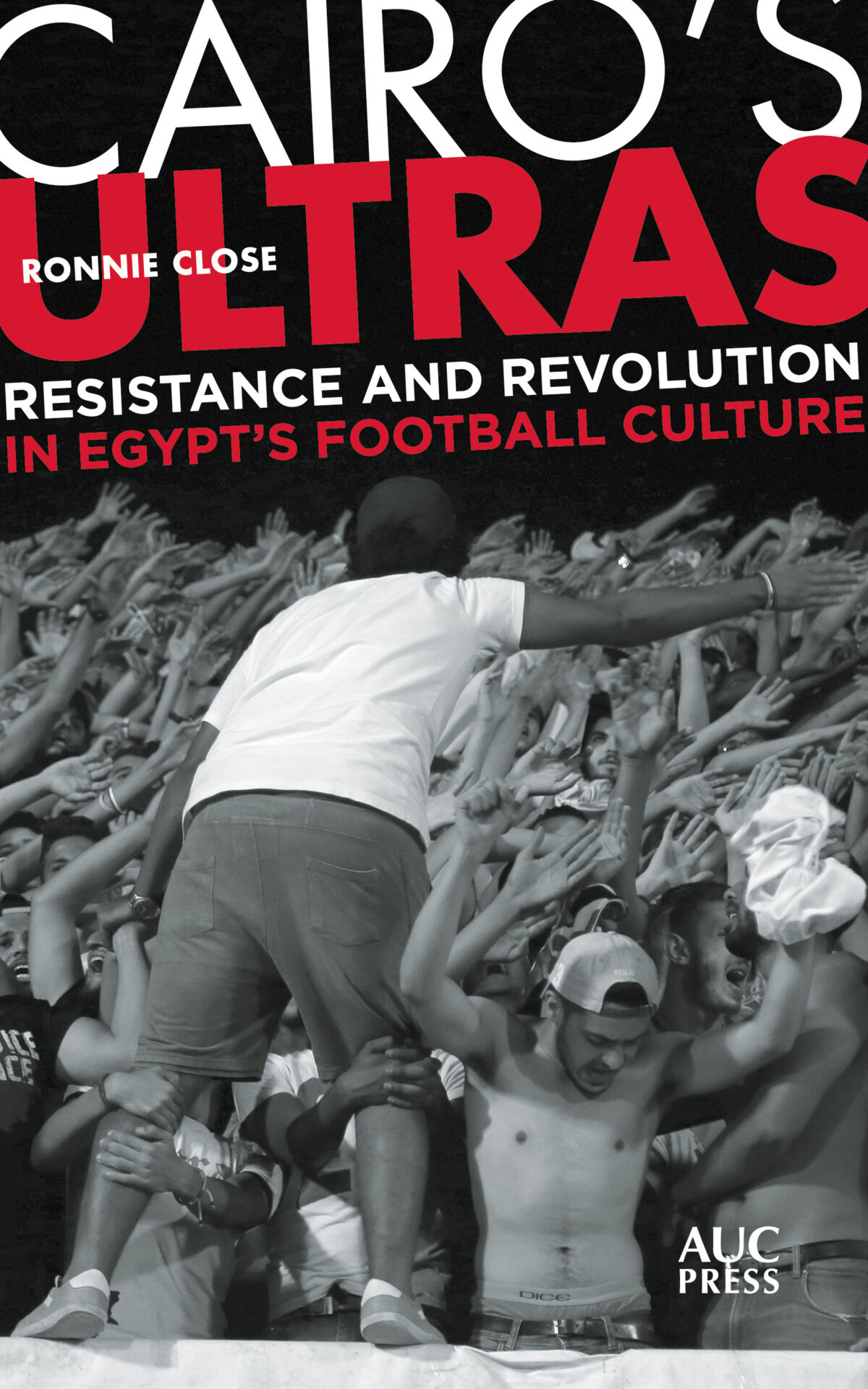
Cairo’s Ultras

(2019) The history of Cairo’s football fans is one of the most poignant narratives of the 25 January 2011 Egyptian uprising. The Ultras Al-Ahly and the Ultras White Knights fans, belonging to the two main teams, Al-Ahly F.C. and Zamalek F.C respectively, became embroiled in the street protests that brought down the Mubarak regime. In the violent turmoil since, the Ultras have been locked in a bitter conflict with the Egyptian security state. Tracing these social movements to explore their role in the uprising and the political dimension of soccer in Egypt, Ronnie Close provides a vivid, intimate sense of the Ultras’ unique subculture. Cairo’s Ultras: Resistance and Revolution in Egypt’s Football Culture explores how football communities offer ways of belonging and instill meaning in everyday life. Close asks us to rethink the labels ‘fans’ or ‘hooligans’ and what such terms might really mean. He argues that the role of the body is essential to understanding the cultural practices of the Cairo Ultras, and that the physicality of the stadium rituals and acerbic chants were key expressions that resonated with many Egyptians. Along the way, the book skewers media clichés and retraces revolutionary politics and social networks to consider the capacity of sport to emancipate through performances on the football terraces.

Cairo of Naguib Mahfouz

(2012) Around the old city in the footsteps of the Nobel laureate For Nobel laureate Naguib Mahfouz (1911–2006), Cairo was always a place of special resonance. As the place in which he was born and lived his whole life, it is a city he loved passionately and visited and revisited in his writing. It is the setting for nearly all his novels and short stories, not merely as a backdrop but as an integral part of his fiction, playing its own role in the dramas. In this special new and expanded edition of the bestselling book first published in 1999, photographer Britta Le Va guides us through his pages, and treads his streets and alleys, to produce a collection of outstanding visual images of the historic city, while novelist Gamal al-Ghitani describes a walking tour with the great man around the streets of Gamaliya, that historic heart of the old city where both of them—more than thirty years apart—were born and grew up.

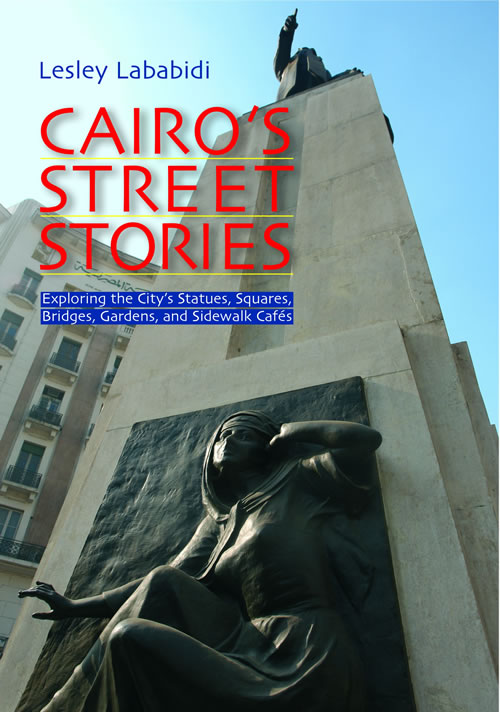
Cairo’s Street Stories

In 1872, Ismail Pasha, the khedive of Egypt, was the first to adopt the European custom of positioning heroic statues on public display as a symbolic message of the continuing authority of the ruling Muhammad Ali dynasty to which he belonged, but it was not until the early twentieth century and the determination of sculptor Mahmoud Mukhtar that such public art gained general acceptance, and today statues stand, ride, or sit in the streets, squares, and gardens of Cairo. Each sculpture adds a piece to the jigsaw of history spanning personalities and events that shaped the city and wider Egypt from 1805 to 1970, and here Cairo-based author Lesley Lababidi provides a unique perspective on Egyptian history through looking at more than fifty statues and monumental sculptures and the stories behind them.

Between statues, she explores Cairoâs growth and its multidimensional identity, as manifested in the development and changing use of city space over the centuries, and examines the relationship of Cairoâs modern denizens with the landscapes, districts, palaces, archaeological sites, cafés, bridges, and gardens of their great and maddening city, the Mother of the World.

Illustrated throughout with color and black-and-white photographs by the author, Cairoâs Street Stories presents a unique and lively view of the history that fashioned the cityâs streets and open spaces, and of the many and often unexpected uses to which its inventive inhabitants put them.

The Cairo Portfolio

These handsome portfolios in a special new gift edition format contain ten fine art prints each of David Roberts’s superb nineteenth-century lithographs of Egypt, ancient and modern. Between 1842 and 1849, on the basis of sketches made on the spot and aided by his excellent memory, David Roberts produced the
drawings that Louis Haghe turned into prints published by Francis Graham Moon. These lithographs appeared in the original hand-painted deluxe edition.

Cairo of the Mamluks

During two and a half centuries of rule by Mamluk sultans, Cairo acquired some of its most impressive medieval architecture, including the historical monuments that today define the city’s architectural heritage. In this comprehensive work of analysis and description, Islamic art historian Doris Behrens-Abouseif highlights the most important factors in the evolution of Mamluk urban architecture, along with the social and political reasons for their patronage as builders of mosques, schools, hospitals, and mausolea. Copiously illustrated with color photographs and architectural plans, Cairo of the Mamluks highlights sixty of the most important Mamluk buildings in Cairo, in chronological order, from the mausoleum built by Shagar al-Durr, in honor of her late husband, the last Ayyubid ruler, to the magnificent madrasa of Sultan Hasan and the funerary complex of al-Ghuri, the last powerful Mamluk sultan. Long a scholar of Cairo’s historic architecture, Doris Behrens-Abouseif draws on Arabic chronicles as well as the latest in contemporary scholarship to offer a remarkably complete history of Cairo’s justly-famous monuments. DORIS BEHRENS-ABOUSEIF is professor of Islamic art and architecture at the School of Oriental and African Studies in London. She is the author of several books, including Islamic Architecture in Cairo: An Introduction (AUC Press, 1998), and editor of Cairo Heritage: Essays in Honor of Laila Ali Ibrahim (AUC Press, 2001).

Complete Pharaohs

This highly readable popular history is also a unique work of reference, containing: • Biographical accounts of all the 170 or more known pharaohs • Lives and personalities of famous kings and queens: Akhenaten, Tutankhamun, Ramesses the Great, Hatshepsut, Nefertiti, Cleopatra • Timelines with at-a-glance guides to the length of each reign • Datafiles for every pharaoh, listing key information such as royal titles, place of burial, and family relationships • The royal cartouches of each king or queen • Tables of genealogies, royal mummies, and main events • Special features on everything from the eight wives of Ramesses the Great to the pharaohs of the Exodus • Portraits of all the major rulers • Diagrams and plans of royal tombs and monuments “Anyone interested in the ancient Egyptians will not find a clearer or more entertaining account of this fascinating world”—British Museum Magazine Also in the series: The Complete Gods and Goddesses of Ancient Egypt The Complete Pyramids The Complete Queens of Egypt The Complete Royal Families of Ancient Egypt The Complete Temples of Ancient Egypt The Complete Tutankhamun The Complete Valley of the Kings

Alexandria Anthology

(2014) Founded by Alexander the Great over 2,300 years ago, Alexandria has belonged both to the Mediterranean and to Egypt, a luxuriant out-planting of Europe on the coast of Africa, but also a city of the East – the fabled cosmopolitan town that fascinated travelers, writers, and poets in the nineteenth and twentieth centuries, where French and Arabic, Italian and Greek were spoken in the cafes and on the streets. In the pages of An Alexandrian Anthology, we follow the delight of travelers discovering the strangeness of the city and its variety and pleasures. Most of all they are haunted by the city’s resplendent past – the famous Library, the temple built by Cleopatra for Antony, the great Pharos lighthouse, one of the seven wonders of the world, of which only traces remain – we follow our travelers here too as they voyage through an immense ghost city of the imagination.