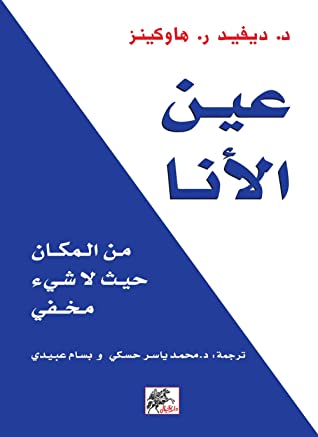
عين الأنا

يعدُّ كتاب “عين الأنا” واحدًا من مجموعة ثلاثية بدأت بكتاب “القوة مقابل الإكراه” وسوف تكتمل بعد هذا الكتاب بكتاب آخر بعنوان “الأنا: الحقيقة مقابل الشخصية”
إنَّ القوة الجوهرية للمعلومات المقدّمة في هذا الكتاب كافية بحدّ ذاتها إلى رفع وعي متلقيها حيث تشمل الكثير من الحوارات الحرفية مع طلاب متقدمين إضافةً إلى الكثير من التعليمات التفسيرات التي توضّح التعاليم الروحية.
إنَّ عين الأنا هو العمل المتألق الذي سيحلُّ العوائق بين المعروف والمجهول..بين العلم والروحانية..بين النموذج الخطي النيوتوني للأنا المزيفة والأنا الحقيقية.
الجدير بالذكر أنَّ مؤلف هذا الكتاب هو دكتور الطب والفلسفة (ديفيد هاوكينز) وهو الرئيس المؤسس لمعهد الأبحاث الروحانية ويعدُّ رائدًا في مجال الوعي الذاتي فضلًا عن أنّه مؤلف ومحاضر وطبيب اكلينيكي ونفساني، وقد لقّبَ ب” معلّم طريق التنوير الأول”

Coptic Civilization

(2014) A comprehensive cultural history of the Copts and their rich contributions of literature, art and architecture, material arts, and music Egypt’s Copts make up one of the oldest and largest Christian communities in the Middle East. Yet despite the availability of a large number of books on aspects of Coptic culture, including art and architecture, monasticism, theology, and music, there is to date no single volume that provides a comprehensive cultural history of the Copts and their achievements. Coptic Civilization aims to fill this gap, by introducing the general reader, the interested non-specialist, to Coptic culture in all its variety and multi-faceted richness. With contributions by twenty scholars, Coptic Civilization includes chapters on monasticism, the Coptic language, Coptic literature, Christian Arabic literature, the objects and documents of daily life, magic, art and architecture, and textiles, as well as the history of the Coptic Church, its liturgy, theology, and music. Contributors: Dominique Bénazeth, Lois Farag, Cنcilia Fluck , Peter Grossmann, Gisele Helmecke, Magdalena Kuhn, Marvin Meyer, Samuel Moawad, Elisabeth R. O’Connell, Monica René , Tonio Sebastian Richter, Saad Michael Saad, Mark Sheridan, Mark N. Swanson, Hany N. Takla , Jacques van der Vliet, Nelly van Doorn-Harder, Gertrud J.M. van Loon, Youhanna Nessim Youssef, Ewa D. Zakrzewska Includes chapters on Coptic Historiography • Church History • Monasticism • Alexandrian Theology • Liturgy • Music • The Coptic Language • Gnosticism and Manichaeism • The Coptic Bible • Coptic Literature • Documentary Evidence of Daily Life • Magic • Copto-Arabic Literature • Archaeology • Architecture • Church Decoration • Objects of Daily Life • Post-pharaonic Textiles • The Coptic Church Today • Contemporary Coptic Art • Coptic Civilization in the Diaspora.

Complete Pyramids

Powerful symbols of remote antiquity, the pyramids have intrigued and fascinated generations. Their secrets are here examined using the latest technology, including the first ever fully illustrated survey of all Egypt’s pyramids. Mark Lehner surveys the history, building, and use of the pyramids in unprecedented scope and detail, looking at the practical aspects—the quarries, ramps, and tools used in building them—as well as the conceptual—the cosmology and iconography of the pyramids and the intriguing Pyramid Texts. Fully illustrated, The Complete Pyramids is a companion volume to The Complete Tutankhamun and The Complete Valley of the Kings, both published by AUC Press.

Cotton Plantation Remembered

(2013) The story of one family’s relation to the land and cotton in a time of social change Cotton made the fortune of the Fuuda family, Egyptian landed gentry with peasant origins, during the second part of the nineteenth century. This story, narrated and photographed by a family member who has researched and documented various aspects of her own history, goes well beyond the family photo album to become an attempt to convey how cotton, as the main catalyst and creator of wealth, produced by the beginning of the twentieth century two entirely separate worlds: one privileged and free, the other surviving at a level of bare subsistence, and indentured. The construction of lavish mansions in the Nile Delta countryside and the landowners’ adoption of European lifestyles are juxtaposed visually with the former laborers’ camp of the permanent workers, which became a village (‘izba), and then an urbanized settlement. The story is retold from the perspective of both the landowners and the former workers who were tied to the ‘izba. The book includes family photo albums, photographs of political campaigns and of banquets in the countryside, documents and accounting books, modern portraits of the peasants, and pictures of daily life in the village today. This is a story that fuses the personal and emotional with the scholar’s detached ethnographic reporting—a truly fascinating, informative, and colorful view of life on both sides of a uniquely Egyptian socio-economic institution, and a vanished world: the cotton estate.

Egypt 1250 BC

(2010) A time-traveler’s guide to sightseeing and survival in the land of the pharaohs Strap on your sturdiest sandals and start planning your trip to Egypt in 1250 BC. You may have heard the rumors: the language is perplexing, there are no tourist facilities, and an aggressive, egocentric pharaoh rules the land. But Egypt will be a must-see vacation destination for millennia to come! So don’t delay—visit now, before the Roman tourist hordes arrive. Drawing on contemporary sources and years of experience excavating in Egypt, archaeologist Donald P. Ryan guides the time-traveling tourist on a journey up the Nile, taking in the sights of Memphis, the pyramids, Thebes, and beyond. En route he offers useful advice on everything from deciphering hieroglyphs to deciding which god to petition in the event of a scorpion sting. So leave the protective amulets at home and banish all fear of being sold as a galley slave. This imaginative guide is all you need to survive and enjoy your visit to Egypt in its glorious age of empire.

Egypt, Moment of Change

A comprehensive and accessible examination of contemporary issues in Egypt There have been few attempts to understand contemporary Egyptian society, in particular growing internal pressures for change and their implications for the Middle East and the wider world. This book presents a series of analyses of politics, culture, and society, addressing the turmoil created by imposition of neo-liberal economic policies, the increasingly fragile nature of an authoritarian regime, the influence of movements for democratic opening and popular participation, and the impacts of Islamism. The authors argue that Egypt has entered a period of instability and assess the ability of the state to resist the new movements and the latters’ capacity to fulfill their aims. Contributors: Anne Alexander, Joel Beinin, Ray Bush, Aida Seif El-Dawla, Rabab El-Mahdi, Philip Marfleet, Ahmed El-Sayed El-Naggar, Sameh Naguib.

Egypt From Alexander to the Copts

After its conquest by Alexander the Great in 332 bc, Egypt was ruled for the next 300 years by the Ptolemaic dynasty founded by Ptolemy I, one of Alexander’s generals. With the defeat of Cleopatra VII in 30 bc, Egypt became a province of the Roman Empire, and later of the Byzantine Empire. For a millennium it was one of the wealthiest, most populous and important lands of the multicultural Mediterranean civilization under Greek and Roman rule. The thousand years from Alexander to the Arab conquest in ad 641 are rich in archaeological interest and well documented by 50,000 papyri in Greek, Egyptian, Latin, and other languages. But travelers and others interested in the remains of this period are ill-served by most guides to Egypt, which concentrate on the pharaonic buildings. This book redresses the balance, with clear and concise descriptions related to documents and historical background that enable us to appreciate the fascinating cities, temples, tombs, villages, churches, and monasteries of the Hellenistic, Roman, and Late Antique periods. Written by a dozen leading specialists and reflecting the latest discoveries and research, it provides an expert visitor’s guide to the principal cities, many off the well-worn tourist paths. It also offers a vivid picture of Egyptian society at differing economic and social levels.

Complete Queens of Egypt

This new volume in the popular Complete series reveals the essential role played by women in the royal household in ancient Egypt. A highly readable and authoritative account, it is ideal for home, university, or school reference

Complete Temples of Ancient Egypt

The temples of ancient Egypt include the largest and perhaps most impressive religious monuments the world has ever known. Mansions of the gods, models of Egypt and of the universe, focal points of worship, great treasure houses and islands of order in a cosmic sea of chaos―the temples were all these things and more.

Now available for the first time in paperback, The Complete Temples of Ancient Egypt traces their development from the earliest times, looking at every aspect of their construction, decoration, symbolism, and function. All of Egypt’s surviving temples are examined in depth with superb illustrations―from the gargantuan temple of Amun at Karnak to minuscule shrines such as the oasis Oracle of Siwa, where Alexander went to hear himself proclaimed god.

Catalogue of Late and Ptolemai

(2020) A documentation, using latest technologies, of the late anthropoid sarcophagi housed in Cairo’s Grand Egyptian Museum

This joint publication project of Cairo University and the University of Tübingen scholars uses modern technologies, including electronic drawing boards, photo merging, and 3-D modeling, to catalogue the late anthropoid sarcophagi housed in Cairo’s Grand Egyptian Museum. Most of this collection was previously known only from the entries in M.-L. Buhl’s The Late Egyptian Anthropoid Stone Sarcophagi (Copenhagen, 1959). This catalogue draws on the efforts of eight team members, each chapter prepared by a joint Egyptian–German team, with the drawings made by the Egyptians and the translations provided by the Germans. The Egyptian Museum photographer Ahmed Amin provided the teams with hundreds of photographs, which were later merged together with the help of Adobe Photoshop. The hieroglyphic texts were composed by JSesh. This, the first catalogue of the Grand Egyptian Museum, was made possible through financial support from the German Academic Exchange Service (DAAD).