Archives

(2016) We give up too easily. With a simple change of attitude, what seem like insurmountable obstacles become once-in-a-lifetime opportunities. Ryan Holiday, who dropped out of college at nineteen to serve as an apprentice to bestselling ‘modern Machiavelli’ Robert Greene and is now a media consultant for billion-dollar brands, draws on the philosophy of the Stoics to guide you in every situation, showing that what blocks our path actually opens one that is new and better.
If the competition threatens you, it’s time to be fearless, to display your courage. An impossible deadline becomes a chance to show how dedicated you are. And as Ryan discovered as Director of Marketing for American Apparel, if your brand is generating controversy – it’s also potentially generating publicity.
The Stoic philosophy – that what is in the way, is the way – can be applied to any problem: it’s a formula invented more than 2,000 years ago, whose effectiveness has been proven in battles and board rooms ever since. From Barack Obama’s ability to overcome obstacles in his election races, to the design of the iPhone, the stoic philosophy has helped its users become world-beaters.
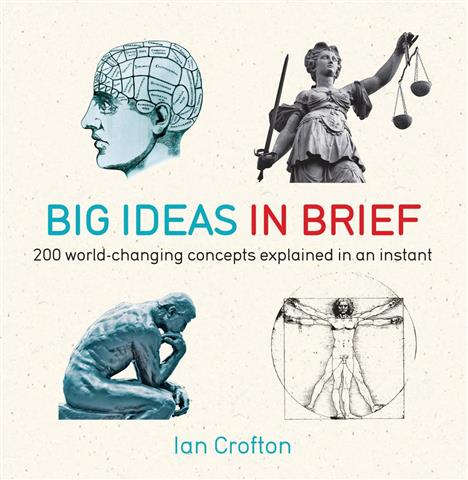
(2012) Big Ideas in Brief provides an accessible and easily understood tour of 200 key concepts that really matter. The ideas covered come from a wide range of subjects – Philosophy, Religion, Science, Politics, Economics, Sociology, Anthropology, Psychology and the Arts.
A series of short and lively articles accompanied by 100 illustrations, introduce a host of diverse topics, from Existentialism to Expressionism, from Consciousness to Constitutionalism, from Feminism to Free Trade, from Class to Cognitive Theory, from Reincarnation to Relativity – all explained simply and clearly.
Incredibly quick – clear artworks and simple explanations that can be easily remembered.
Based on scientific research that the brain best absorbs information visually.
Compact and portable format – the ideal, handy reference

(2020) Stuffed full of festive fun, this book has over 300 Christmas jokes, including cracking one-liners, silly puns, tongue twisters, knock knocks and much more. Designed to be easy to read with wonderfully silly illustrations for extra laughs, this hilarious collection will keep jokers entertained for hours over Christmas.

(2016) ‘No role is so well suited to philosophy as the one you happen to be in right now.’ Marcus Aurelius
The Stoics’ unique blend of practicality and wisdom has been inspiring the most successful among us for centuries, from Roman Emperors to Barack Obama, and most recently via Ryan Holiday’s bestselling The Obstacle is the Way. If that book introduced readers to the idea that what is in the way is the way, The Daily Stoic widens our view on the Stoic philosophy and shows that it can be applied to any problem.
From how to manage failure to getting what you want, the ideas of Seneca, Epictetus, Marcus Aurelius and others continue to be vitally relevant to today’s doers and thinkers. Here, in bold new translations of the ancient classics, language is stripped down to reveal powerful aphorisms that cut straight to the heart of our day-to-day challenges.
Presented in a page-per-day format, this daily resource of Stoic inspiration combines quotations with calls to further reflection – and action. Arranged topically, this guide features twelve principles for overcoming obstacles and achieving greater satisfaction. It introduces readers to a new daily ritual and new orientation that will bring them balanced action, insight, effectiveness, and serenity.

Clears out the mumbo jumbo and muddled thinking underlying too many strategies and provides a clear way to create and implement a powerful action-oriented strategy for the real world Developing and implementing a strategy is the central task of a leader, whether the CEO at a Fortune 100 company, an entrepreneur, a church pastor, the head of a school, or a government official. Richard Rumelt shows that there has been a growing and unfortunate tendency to equate Mom-and-apple-pie values, fluffy packages of buzzwords, motivational slogans, and financial goals with “strategy.” He debunks these elements of “bad strategy” and awakens an understanding of the power of a “good strategy.”A good strategy is a specific and coherent response to—and approach for overcoming—the obstacles to progress. A good strategy works by harnessing and applying power where it will have the greatest effect in challenges as varied as putting a man on the moon, fighting a war, launching a new product, responding to changing market dynamics, starting a charter school, or setting up a government program. Rumelt’snine sources of power—ranging from using leverage to effectively focusing on growth—are eye-opening yet pragmatic tools that can be put to work on Monday morning.Surprisingly, a good strategy is often unexpected because most organizations don’t have one. Instead, they have “visions,” mistake financial goals for strategy,and pursue a “dog’s dinner” of conflicting policies and actions.Rumelt argues that the heart of a good strategy is insight—into the true nature of the situation, into the hidden power in a situation, and into an appropriate response. He shows you how insight can be cultivated with a wide variety of tools for guiding yourown thinking.Good Strategy/Bad Strategy uses fascinating examples from business, nonprofit, and military affairs to bring its original and pragmatic ideas to life. The detailed examples range from Apple to General Motors, from the two Iraq wars to Afghanistan, from a small local market to Wal-Mart, from Nvidia to Silicon Graphics, from the Getty Trust to the Los Angeles Unified School District, from Cisco Systems to Paccar, and from Global Crossing to the 2007–08 financial crisis.Reflecting an astonishing grasp and integration of economics, finance, technology, history, and the brilliance and foibles of the human character, Good Strategy/Bad Strategy stems from Rumelt’s decades of digging beyond the superficial to address hard questions with honesty and integrity.From the Hardcover edition.

(2016) There isn’t a business that doesn’t want to be more creative in its thinking, products and processes. In The Art of Innovation, Tom Kelley, partner at the Silicon Valley-based firm IDEO, developer of hundreds of innovative products from the first commercial mouse to virtual reality headsets and the Palm hand-held, takes readers behind the scenes of this wildly imaginative company to reveal the strategies and secrets it uses to turn out hit after hit.
Kelley shows how teams:
-Research and immerse themselves in every possible aspect of a new product or service
-Examine each product from the perspective of clients, consumers and other critical audiences
-Brainstorm best when they are focussed, being physical and having fun
The Art of Innovation will provide business leaders with the insights and tools they need to make their companies the leading-edge top-rated stars of their industries.

(2016) In business – as in life – the right behaviours matter. But getting it right is tricky. Even when we acknowledge the need to change what we do and how we do it, life has a habit of getting in the way, upsetting even the best-laid plans. And just how do we manage those situations that can provoke even the most rational among us into behaving in ways we would rather forget?
Triggers confronts head-on the challenges of behaviour and change, looking at the external factors (or ‘triggers’) – both negative and positive – that affect our behaviours, our awareness of when we need to change, our willingness (or otherwise) to do so and our ability to see the change through.
Drawing on his unparalleled experience as an international executive educator and coach, Marshall Goldsmith invites us to understand how our own beliefs and the environments in which we operate can trigger negative behaviours, or a resistance to the need to change. But he also offers up some simple, practical advice to help us navigate the negative and make the most of the triggers that will help us to sustain positive change.

(2016) Business growth is a clear goal for ambitious entrepreneurs and leaders. It’s often a short hand for business – and wider economic – success. But it’s not without its pitfalls and challenges, and planning for, and managing, a growing business needs careful thought.
Take, for example, the start-up facing for the first time the need to balance flexibility with more structure. Or a larger business tackling a range of divisions evolving at different speeds. Or an inspirational owner-founder confronting the need to step back and let others take the business forward.
These are the kinds of challenges that Growing a Business tackles head-on. Drawing on a wide range of models and research, and using case studies from across the business world, it offers practical advice and guidance on a whole range of topics, including:
– the different types and stages of growth;
– predicting the problems presented by growth;
– identifying growth triggers – and barriers;
– the implications of growth: financially, culturally and for the people involved in the business.
Growing a Business is required reading for owners and managers looking to understand and foster growth in their businesses.
An Economist Book, published in association with the Economist.