

Archives

(2012) Now shortlisted for the Financial Times and Goldman Sachs Business Book of the Year Award 2012. Why are some nations more prosperous than others? Why Nations Fail sets out to answer this question, with a compelling and elegantly argued new theory: that it is not down to climate, geography or culture, but because of institutions. Drawing on an extraordinary range of contemporary and historical examples, from ancient Rome through the Tudors to modern-day China, leading academics Daron Acemoglu and James A. Robinson show that to invest and prosper, people need to know that if they work hard, they can make money and actually keep it – and this means sound institutions that allow virtuous circles of innovation, expansion and peace. Based on fifteen years of research, and answering the competing arguments of authors ranging from Max Weber to Jeffrey Sachs and Jared Diamond, Acemoglu and Robinson step boldly into the territory of Francis Fukuyama and Ian Morris. They blend economics, politics, history and current affairs to provide a new, powerful and persuasive way of understanding wealth and poverty.

(2009) If you change your brain, you can change your life.
Great teachers like the Buddha, Jesus, Moses, Mohammed, and Gandhi were all born with brains built essentially like anyone else’s?and then they changed their brains in ways that changed the world. Science is now revealing how the flow of thoughts actually sculpts the brain, and more and more, we are learning that it’s possible to strengthen positive brain states.
By combining breakthroughs in neuroscience with insights from thousands of years of mindfulness practice, you too can use your mind to shape your brain for greater happiness, love, and wisdom. Buddha’s Brain draws on the latest research to show how to stimulate your brain for more fulfilling relationships, a deeper spiritual life, and a greater sense of inner confidence and worth. Using guided meditations and mindfulness exercises, you’ll learn how to activate the brain states of calm, joy, and compassion instead of worry, sorrow, and anger. Most importantly, you will foster positive psychological growth that will literally change the way you live in your day-to-day life.
This book presents an unprecedented intersection of psychology, neurology, and contemplative practice, and is filled with practical tools and skills that you can use every day to tap the unused potential of your brain and rewire it over time for greater well-being and peace of mind.

(2018) When you feel anxious, angry, happy, or surprised, what’s really going on inside of you?
Many scientists believe that emotions come from a specific part of the brain, triggered by the world around us. The thrill of seeing an old friend, the fear of losing someone we love – each of these sensations seems to arise automatically and uncontrollably from within us, finding expression on our faces and in our behaviour, carrying us away with the experience.
This understanding of emotion has been around since Plato. But what if it is wrong? In How Emotions Are Made, pioneering psychologist and neuroscientist Lisa Feldman Barrett draws on the latest scientific evidence to reveal that our common-sense ideas about emotions are dramatically, even dangerously, out of date – and that we have been paying the price. Emotions aren’t universally pre-programmed in our brains and bodies; rather they are psychological experiences that each of us constructs based on our unique personal history, physiology and environment.
This new view of emotions has serious implications: when judges issue lesser sentences for crimes of passion, when police officers fire at threatening suspects, or when doctors choose between one diagnosis and another, they’re all, in some way, relying on the ancient assumption that emotions are hardwired into our brains and bodies. Revising that conception of emotion isn’t just good science, Barrett shows; it’s vital to our well-being and the health of society itself.

Introducing Kokology — the fascinating, addictive pop-psych quiz game that reveals the surprising real you.
Created by a famous Japanese psychologist, kokology is the study of kokoro (“mind” or “spirit” in Japanese). Based on sound psychological principles, Kokology asks you to answer questions about seemingly innocent topics — such as the color of an imaginary bird that has flown in your window — and then reveals what your answers say about you. Kokology offers a unique approach to self-discovery and, when played with others, can provide hilarious insight into the you that they never knew.

What you need to know to have the best birth experience for you. Drawing upon her thirty-plus years of experience, Ina May Gaskin, the nation’s leading midwife, shares the benefits and joys of natural childbirth by showing women how to trust in the ancient wisdom of their bodies for a healthy and fulfilling birthing experience. Based on the female-centered Midwifery Model of Care, Ina May’s Guide to Natural Childbirth gives expectant mothers comprehensive information on everything from the all-important mind-body connection to how to give birth without technological intervention.
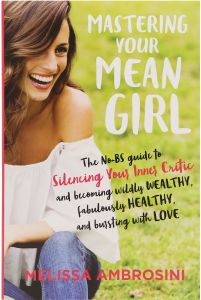
(2016) You know that sneaky voice inside your head telling you that you’re not good enough, smart enough, pretty enough, whatever enough? That’s your Mean Girl. And she’s doing her best to keep you stuck in Fear Town, too scared to go after the life you always imagined.
But enough’s enough! Melissa Ambrosini has made a life beyond her wildest dreams, all by mastering her Mean Girl, busting through limiting beliefs and karate-chopping through the fears that held her hostage for years. And now she wants to help you remember not only what you are capable of, but how amazing you truly are!
In this inspiring, upbeat guide, Melissa provides a practical plan for creating your own version of a kick-ass life — one that’s wildly wealthy, fabulously healthy and bursting with love. Designed to propel you out of stuck-ness and into action, this is a must read if you’re ready to let go of your Mean Girl and start living the life of your dreams.

2014What can a brain scan, or our reaction to a Caravaggio painting, reveal about the deep seat of guilt?
How can reading Heidegger, or conducting experiments on rats, help us to cope with anxiety in the face of the world’s economic crisis?
Can ancient remedies fight sadness more effectively than anti-depressants?
What does the neuroscience of acting tell us about how we feel empathy, and fall for an actor on stage?
What can writing poetry tell us about how joy works?
And how can a bizarre neurological syndrome or a Shakespearean sonnet explain love and intimacy?
We live at a time when neuroscience is unlocking the secrets of our emotions. But is science ever enough to explain why we feel the way we feel?
Giovanni Frazzetto takes us on a journey through our everyday lives and most common emotions. In each chapter, his scientific knowledge mixes with personal experience to offer a compelling account of the continual contrast between rationality and sentiment, science and poetry. And he shows us that by facing this contrast, we can more fully understand ourselves and how we feel.

(2019) There are few subjects in American life that prompt more discussion and controversy than immigration. But do we really understand it? In This Land Is Our Land, the renowned author Suketu Mehta attacks the issue head-on. Drawing on his own experience as an Indian-born teenager growing up in New York City and on years of reporting around the world, Mehta subjects the worldwide anti-immigrant backlash to withering scrutiny. As he explains, the West is being destroyed not by immigrants but by the fear of immigrants. Mehta juxtaposes the phony narratives of populist ideologues with the ordinary heroism of laborers, nannies, and others, from Dubai to Queens, and explains why more people are on the move today than ever before. As civil strife and climate change reshape large parts of the planet, it is little surprise that borders have become so porous. But Mehta also stresses the destructive legacies of colonialism and global inequality on large swaths of the world: When today’s immigrants are asked, “Why are you here?” they can justly respond, “We are here because you were there.” And now that they are here, as Mehta demonstrates, immigrants bring great benefits, enabling countries and communities to flourish. Impassioned, rigorous, and richly stocked with memorable stories and characters, This Land Is Our Land is a timely and necessary intervention, and a literary polemic of the highest orde

(2016) The bestselling Games People Play is the book that has helped millions of people understand the dynamics of relationships, by psychiatrist Eric Berne.
We all play games. In every encounter with other people we are doing so. The nature of these games depends both on the situation and on who we meet.
Eric Berne’s classic Games People Play is the most accessible and insightful book ever written about the games we play: those patterns of behaviour that reveal hidden feelings and emotions. Wise and witty, it shows the underlying motivations behind our relationships and explores the roles that we try to play – and are forced to play.
Games People Play gives you the keys to unlock the psychology of others – and yourself. You’ll become more honest, more effective, and a true team player.
‘A brilliant, amusing, and clear catalogue of the psychological theatricals that human beings play over and over again’ Kurt Vonnegut
Eric Berne was a prominent psychiatrist and bestselling author.After inventing his groundbreaking Transactional Analysis, he continued to develop and apply this new methodology leading him to publish Games People Play. This became a runaway success and Berne leaves a remarkable legacy of over 30 other books and articles, as well as the founding of the International Transactional Analysis Association.
Dr Berne’s other works include Principles of Group Treatment, A Layman’s Guide to Psychiatry and Psychoanalysis’, and What Do You Say After You Say Hello? He died in 1970.